

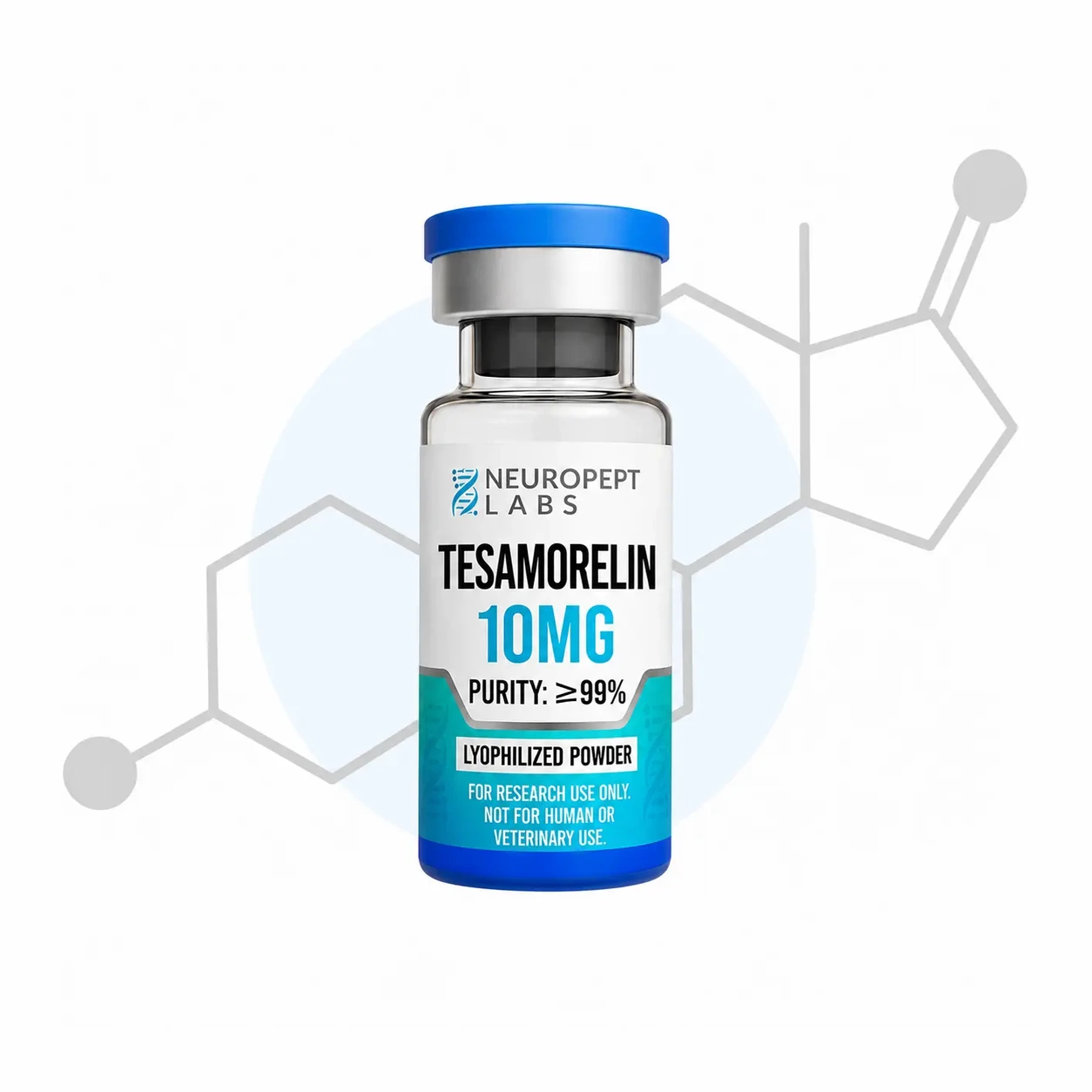
Tesamorelin 10mg | NeuroPept Labs
$79.00
In stock
Tesamorelin 10mg is a research-grade stabilized synthetic analogue of growth hormone-releasing hormone (GHRH), studied for pulsatile GH secretion, IGF-1 signalling, and visceral adipose tissue metabolism. Its N-terminal trans-3-hexenoyl modification gives it markedly greater stability than native GHRH.
Purity: >99% (HPLC verified) | Format: Lyophilized powder | Amount: 10mg | COA: Verifiable at freedomdiagnosticstesting.com | Intended use: In vitro laboratory research only.
Description
Tesamorelin 10mg is a synthetic 44-amino-acid analogue of growth hormone-releasing hormone (GHRH), studied extensively in metabolic and endocrine research. Through an N-terminal trans-3-hexenoyl modification, Tesamorelin achieves enhanced molecular stability and resistance to enzymatic degradation compared with native GHRH, making it a widely used tool compound for investigating pulsatile growth hormone secretion, IGF-1 signalling, and visceral adipose tissue biology.
NeuroPept Labs supplies Tesamorelin 10mg as a research-grade lyophilized peptide intended strictly for in vitro laboratory and analytical research use. All batches are synthesised under controlled conditions and verified through third-party analytical testing. COA validity can be confirmed at freedomdiagnosticstesting.com using the Accession Number, Client ID, or Search Code found in the product images.
Tesamorelin Mechanism of Action (Research Overview)
Tesamorelin is posited to mimic native GHRH by binding GHRH receptors on anterior-pituitary somatotrophs, initiating an intracellular signalling cascade:
- cAMP production — stimulates adenylate cyclase, raising cyclic adenosine monophosphate levels
- PKA activation — elevated cAMP activates protein kinase A, a key signal-transduction enzyme
- Growth hormone secretion — the cAMP-PKA cascade promotes synthesis and pulsatile release of endogenous growth hormone
- IGF-1 elevation — hepatocytes respond to released GH by synthesising insulin-like growth factor-1, the primary anabolic mediator
- Enhanced stability — the trans-3-hexenoyl group reinforces the peptide against enzymatic breakdown, extending its research half-life
Research Applications
Current laboratory and preclinical investigation using the peptide spans multiple research domains:
- Visceral adipose tissue research — lipodystrophy models measuring reductions in visceral and trunk fat
- Hepatic fat and NAFLD research — non-alcoholic fatty liver disease models tracking hepatic fat fraction
- GH/IGF-1 axis biology — pulsatile secretion dynamics and IGF-1 response
- Metabolic and lipid research — triglyceride and cholesterol profiles, insulin sensitivity endpoints
- Body composition and lean mass — imaging-based analysis of muscle density and fat distribution
Product Specifications
| Specification | Detail |
| Peptide Name | Tesamorelin |
| Sequence | N-(trans-3-hexenoyl)-[Tyr1]hGRF(1-44)NH2 |
| Molecular Formula | C221H366N72O67S |
| Molecular Weight | 5135.9 g/mol |
| Receptor Target | GHRH receptor (anterior pituitary) |
| Synonyms | TH9507, (3E)-hex-3-enoylsomatoliberin |
| Format | Lyophilized powder |
| Amount | 10mg per vial |
| Purity | >99% (HPLC verified) |
| Storage | -20°C or below, away from moisture and light |
| Reconstitution | Sterile bacteriostatic water (in vitro laboratory preparation) |
| Intended Use | In vitro laboratory research only |
| COA Verification | freedomdiagnosticstesting.com |
Storage and Handling
- Store lyophilized peptide at -20°C or below prior to reconstitution
- Avoid repeated freeze-thaw cycles to preserve structural integrity
- Protect from direct light, humidity, and room temperature exposure
- Reconstitute using sterile bacteriostatic water under aseptic conditions
- Once reconstituted, store at 4°C and use within recommended research timeframes
Frequently Asked Questions
What is Tesamorelin?
It is a stabilized synthetic analogue of growth hormone-releasing hormone (GHRH), and binds GHRH receptors on pituitary somatotrophs to promote pulsatile growth hormone secretion and downstream IGF-1 production, and is widely studied in visceral-fat and metabolic research.
How is Tesamorelin different from native GHRH?
The peptide adds an N-terminal trans-3-hexenoyl group to the GHRH(1-44) sequence, substantially increasing resistance to enzymatic degradation and extending its functional half-life relative to native GHRH in research models.
Is Tesamorelin studied alongside Ipamorelin?
Yes. Tesamorelin (a GHRH-receptor agonist) and Ipamorelin (a GHS-R1a/ghrelin-receptor agonist) act on complementary pathways of the growth hormone axis, and are frequently combined in dual-pathway secretion research.
What purity is NeuroPept Labs’ Tesamorelin 10mg?
Our Tesamorelin 10mg research peptide is supplied at >99% purity, verified by HPLC and third-party analytical testing. Full COA documentation is available for every batch and can be verified at freedomdiagnosticstesting.com.
Scientific References
- Metabolic Effects of a Growth Hormone-Releasing Factor in Patients with HIV | NEJM 2007
- Growth Hormone and Tesamorelin in the Management of HIV-Associated Lipodystrophy | PMC 2011
Research Use Disclaimer: All products sold by NeuroPept Labs are intended strictly for in vitro laboratory research and scientific investigation by qualified professionals. They are not approved for human consumption, medical treatment, or veterinary use. Purchasers are responsible for compliance with applicable regulations in their jurisdiction.
Only logged in customers who have purchased this product may leave a review.
Related product(s)
CJC-1295 NO DAC 10 mg| NeuroPept Labs
Original price was: $55.00.$49.00Current price is: $49.00.
Selank 10mg | NeuroPept Labs
$45.00
Reviews
There are no reviews yet.