GLOW Blend Peptide: A Comprehensive Research Guide to GHK-Cu, BPC-157 & TB-500 (2026)
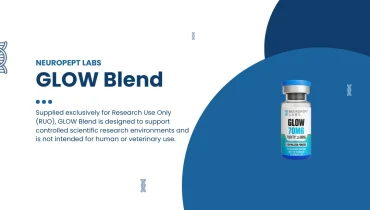
GLOW Blend is a multi-peptide research formulation that combines three of the most studied compounds in regenerative peptide science: GHK-Cu (Copper Tripeptide), BPC-157 (Body Protective Compound-157), and TB-500 (Thymosin Beta-4 fragment). Designed exclusively for in vitro and laboratory research use, this tri-peptide blend has become a subject of increasing scientific interest due to the potential synergistic interactions among its components.
Research Use Only (RUO): All products on NeuroPept Labs are supplied strictly for controlled laboratory and scientific research applications. They are not intended for human or veterinary use, diagnostic purposes, or clinical application.
What Is the GLOW Blend Peptide?
The GLOW Blend Peptide is a research-grade, multi-peptide formulation composed of three distinct synthetic and naturally occurring peptides, each with well-documented mechanisms studied across hundreds of peer-reviewed publications. The three components — GHK-Cu, BPC-157, and TB-500 — target overlapping but distinct biological pathways, making GLOW Blend a particularly valuable research tool for scientists studying tissue remodeling, extracellular matrix dynamics, angiogenesis, and inflammation modulation.
GLOW Blend is available in lyophilized powder form, with a purity of >98% (HPLC-verified), and is recommended for storage at −20°C in sealed, light-protected conditions.

The Three Peptides: Mechanisms & Research Background
GHK-Cu (Copper Tripeptide)
GHK-Cu (glycyl-L-histidyl-L-lysine copper complex) is a naturally occurring tripeptide found in human plasma, saliva, and urine. Plasma GHK levels average approximately 200 ng/mL at age 20, declining to roughly 80 ng/mL by age 60, a pattern that has led researchers to investigate its potential role in age-related tissue changes.
Scientific research on GHK-Cu has explored the following mechanisms:
- Collagen and elastin synthesis: GHK-Cu has been shown to stimulate both the synthesis and breakdown of collagen and glycosaminoglycans, enabling dynamic extracellular matrix remodeling
- Fibroblast activity: Research models demonstrate GHK-Cu supports dermal fibroblast function and proliferation
- Angiogenesis: GHK-Cu upregulates vascular endothelial growth factor (VEGF) and fibroblast growth factor 2 (FGF2) in studied models
- Gene expression modulation: Genome-wide data suggests GHK-Cu influences expression of 31.2% of human genes (by a criterion of >50% change), including pathways associated with tissue repair and anti-inflammatory signaling
- Anti-inflammatory signaling: Preclinical data show suppression of TNF-α, TGF-β1, and NFκB — key pro-inflammatory mediators
A 2018 review published in International Journal of Molecular Sciences (Pickart & Margolina, 2018) confirmed GHK-Cu’s role in stimulating blood vessel and nerve outgrowth, enhancing dermal fibroblast support, and demonstrating cell-protective activity across multiple tissue types.
BPC-157 (Body Protective Compound-157)
BPC-157 is a synthetic pentadecapeptide (15 amino acids) derived from a protective sequence found in human gastric juice. It has been extensively studied in animal models across a wide range of tissue types, including muscle, tendon, ligament, bone, and gastrointestinal tissue.
Key mechanisms studied in research models include:
- Angiogenesis: BPC-157 has been shown to promote formation of new blood vessels via upregulation of VEGF and modulation of nitric oxide (NO) pathways
- Fibroblast activation: Research demonstrates BPC-157 increases growth hormone receptor expression in fibroblasts, supporting tissue reconstruction signals
- Anti-inflammatory cytokine modulation: Studies report reduced expression of pro-inflammatory cytokines and improved microvascular integrity in treated models
- Collagen synthesis: BPC-157 supports collagen deposition in wound healing models, with complementary activity to both GHK-Cu and TB-500
A 2026 narrative review (Int J Mol Sci, DOI: 10.3390/ijms27062876) confirmed that experimental evidence demonstrates BPC-157 supports angiogenesis, collagen synthesis, and fibroblast activity, while noting that human clinical data remains limited and further controlled trials are needed.
TB-500 (Thymosin Beta-4 Fragment)
TB-500 is a synthetic peptide fragment derived from Thymosin Beta-4 (Tβ4), a full 43-amino-acid peptide naturally produced by the thymus. TB-500 corresponds to the actin-binding domain of Tβ4 — the functional fragment associated with cellular migration and repair activity.
Research on TB-500 and its parent molecule Tβ4 has explored:
- Cellular migration: TB-500 promotes actin regulation and cell motility, essential processes in wound closure and tissue remodeling
- Reepithelialization: In rat full-thickness wound models, Tβ4 increased reepithelialization by 42% at day 4 and up to 61% at day 7 over saline controls
- Collagen deposition: Treated wound models showed increased collagen deposition relative to controls
- Angiogenesis: TB-500 stimulates formation of new capillaries in research models, supporting vascular remodeling alongside BPC-157
TB-500 is particularly valued in multi-peptide research formulations for its distinct mechanism — primarily actin-mediated cellular migration — which does not overlap directly with the collagen-signaling or copper-mediated pathways of GHK-Cu.

GLOW Blend: Peptide Mechanism Comparison
| Property | GHK-Cu | BPC-157 | TB-500 |
|---|---|---|---|
| Origin | Natural human plasma tripeptide | Synthetic gastric-derived pentadecapeptide | Synthetic Thymosin Beta-4 fragment |
| Primary Mechanism | Collagen/ECM remodeling, gene modulation | Angiogenesis, NO pathway modulation | Actin-mediated cellular migration |
| Collagen Involvement | Direct stimulation | Fibroblast support | Deposition in wound models |
| Angiogenesis | VEGF/FGF2 upregulation | VEGF, NO pathways | Capillary formation |
| Anti-inflammatory | TNF-α, NF-κB suppression | Cytokine modulation | Inflammation reduction |
| Cellular Migration | Partial (fibroblast) | Partial (fibroblast activation) | Primary mechanism |
| Research Model Types | Dermal, connective tissue, gene expression | Musculoskeletal, GI, vascular | Wound healing, musculoskeletal |
Synergistic Research Potential of the GLOW Blend
The value of multi-peptide research formulations such as GLOW lies in the ability to study peptide interactions across converging biological pathways. While each of the three components has been independently researched, their combined activity represents a research model that simultaneously engages:
- Extracellular matrix remodeling (GHK-Cu: collagen/elastin synthesis and breakdown)
- Vascular remodeling and angiogenesis (BPC-157 + TB-500: parallel VEGF and NO pathway engagement)
- Cellular migration and repair scaffolding (TB-500: actin regulation)
- Broad transcriptional modulation (GHK-Cu: >31% gene expression influence)
- Multi-pathway anti-inflammatory signaling (all three components via distinct cytokine mechanisms)
This convergence makes GLOW Blend particularly suitable for exploratory and hypothesis-driven studies investigating complex tissue repair cascades, dermatological research models, and inflammatory pathway analysis in controlled laboratory settings.
Research Applications of GLOW Blend
GLOW Blend is utilized in scientific research contexts including:
- Skin biology research: Studying collagen signaling, epidermal repair, and extracellular matrix dynamics in cell culture models
- Wound healing models: Evaluating reepithelialization, fibroblast migration, and collagen deposition in vitro
- Inflammatory pathway studies: Analyzing cytokine modulation and NFκB signaling under multi-peptide conditions
- Comparative peptide research: Assessing differences between individual peptide activity and combined formulation activity
- Angiogenic research models: Studying vascular remodeling and capillary formation in laboratory environments
How to Source GLOW Blend for Research
NeuroPept Labs supplies GLOW Blend (GHK-Cu + BPC-157 + TB-500) in a lyophilized, research-grade format at ≥98% purity (HPLC-verified), with a Certificate of Analysis (CoA) available for each batch. The product is supplied in a 70 mg format and intended exclusively for Research Use Only (RUO) applications.
Frequently Asked Questions About GLOW Blend Peptide
Q: What is the GLOW Blend Peptide?GLOW Blend is a tri-peptide research formulation composed of GHK-Cu (Copper Tripeptide), BPC-157, and TB-500. It is designed for in vitro and laboratory research studying tissue remodeling, angiogenesis, collagen signaling, and inflammation modulation.
Q: What are the three peptides in GLOW Blend?The GLOW Blend contains: (1) GHK-Cu, a naturally occurring copper tripeptide studied for collagen synthesis and gene modulation; (2) BPC-157, a synthetic pentadecapeptide studied for angiogenesis and fibroblast activation; and (3) TB-500, a synthetic Thymosin Beta-4 fragment studied for actin-mediated cellular migration and wound closure.
Q: Is GLOW Blend for human use?No. GLOW Blend is supplied exclusively for Research Use Only (RUO) in controlled laboratory settings. It is not intended for human or veterinary use, clinical application, or diagnostic procedures.
Q: What purity is NeuroPept Labs’ GLOW Blend?NeuroPept Labs provides GLOW Blend at ≥98% purity, verified by HPLC analysis, with a Certificate of Analysis available for each batch.
Q: How does GHK-Cu differ from BPC-157 in the GLOW Blend?GHK-Cu primarily works through copper-mediated collagen/ECM remodeling and broad gene expression modulation, while BPC-157 targets angiogenesis and fibroblast activation through nitric oxide and growth hormone receptor pathways. Together they provide complementary collagen and vascular support pathways in research models.
Q: What research models is GLOW Blend used for?GLOW Blend is used in skin biology, wound healing, inflammatory pathway, and angiogenic research models. It is particularly valuable for comparative studies between single-peptide and multi-peptide formulations.
Q: How should GLOW Blend be stored?GLOW Blend should be stored at −20°C in a sealed container, protected from light and moisture. It is soluble in sterile water or laboratory-grade buffers suitable for peptide research.
Research Disclaimer
All products sold by NeuroPept Labs, including GLOW Blend, are intended exclusively for in vitro research and laboratory use. These products have not been evaluated by the FDA or any regulatory authority for safety or efficacy in humans or animals. They are not drugs, supplements, or medical devices, and must not be used for human or veterinary consumption, diagnostic purposes, or therapeutic applications. All research must be conducted in compliance with applicable local regulations and institutional guidelines.
Scientific References
- Pickart, L., & Margolina, A. (2018). Regenerative and Protective Actions of the GHK-Cu Peptide in the Light of the New Gene Data. International Journal of Molecular Sciences, 19(7), 1987. https://doi.org/10.3390/ijms19071987 · PMCID: PMC6073405
- Pickart, L. (2008). The human tri-peptide GHK and tissue remodeling. Journal of Biomaterials Science, Polymer Edition, 19(8), 969–988. https://doi.org/10.1163/156856208784909435 · PMID: 18644225
- Pickart, L., Vasquez-Soltero, J.M., & Margolina, A. (2015). GHK Peptide as a Natural Modulator of Multiple Cellular Pathways in Skin Regeneration. BioMed Research International. PMCID: PMC4508379
- Sikiric, P. et al. (2026). From Regeneration to Analgesia: The Role of BPC-157 in Tissue Repair and Pain Management. International Journal of Molecular Sciences. https://doi.org/10.3390/ijms27062876
- Malinda, K.M. et al. (1999). Thymosin beta4 accelerates wound healing. Journal of Investigative Dermatology, 113(3), 364–368. https://doi.org/10.1046/j.1523-1747.1999.00708.x · PMID: 10469335
- Pickart, L., & Margolina, A. (2020). The potential of GHK as an anti-aging peptide. Frontiers in Aging Neuroscience. PMCID: PMC8789089